 Melissa's Botanicals
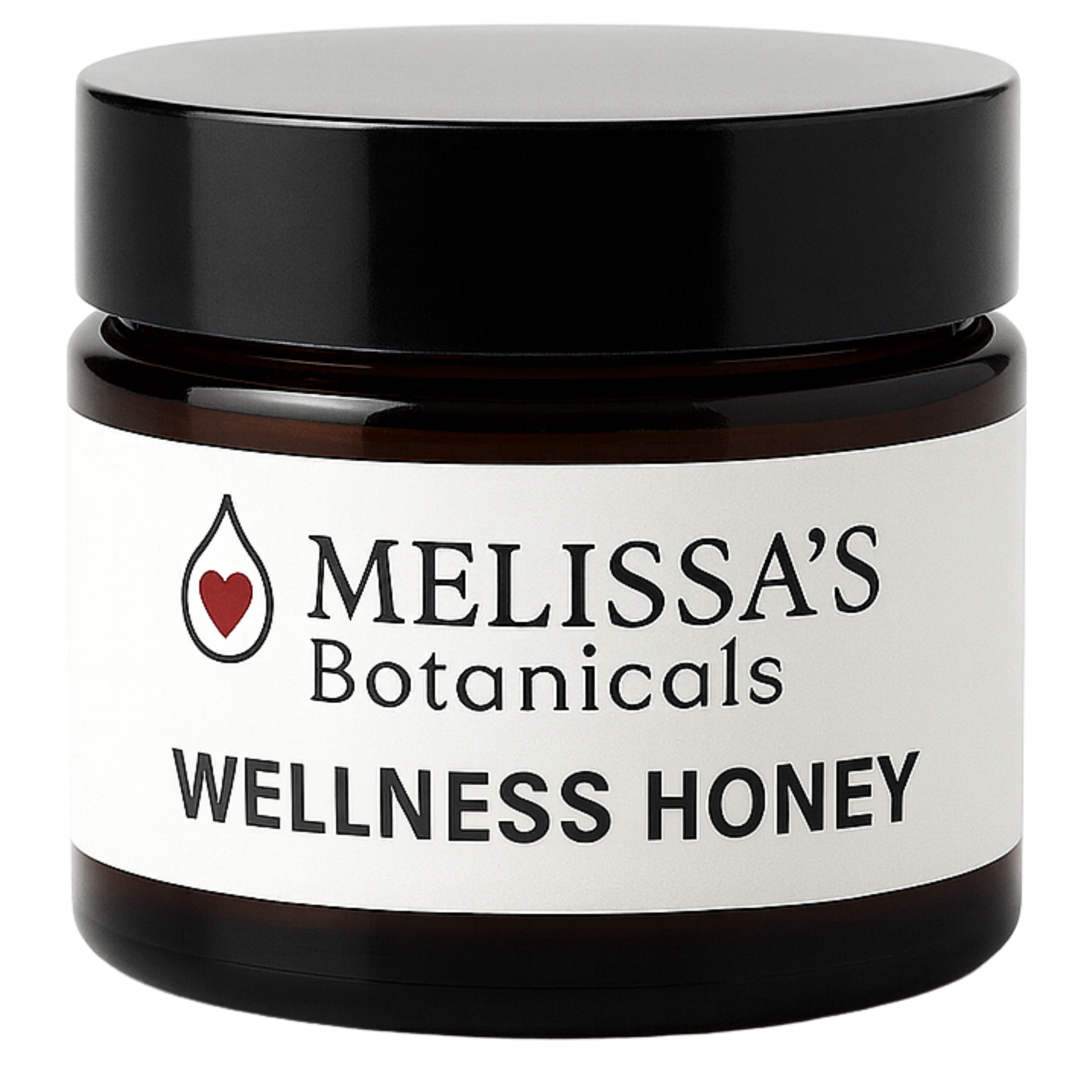
WELLNESS HONEY | Melissa’s Botanicals’ Signature Wellness Elixir
Melissa’s Chemistry Chart in Action: Plant Chemistry You Can Feel and Believe In.
Our Wellness Honey is a powerful therapeutic blend formulated to support the immune system, soothe the respiratory tract, and promote internal balance. At its base is raw Manuka honey combined with biodynamic wildflower honey— This honey is infused with a synergistic array of organic essential oils, chosen for their broad-spectrum antibacterial, antiviral, and anti-inflammatory benefits.
About
Wellness Honey
Melissa’s Botanicals’ Signature Medicinal Elixir — Sold in French Pharmacies
Our Wellness Honey is a powerful therapeutic blend formulated to support the immune system, soothe the respiratory tract, and promote internal balance.
At its foundation is raw Manuka honey combined with biodynamic wildflower honey, infused with 37 pure organic medicinal essential oils, carefully selected for their unique chemistry and remarkable therapeutic properties.
This extraordinary formula highlights the medicinal benefits of menthol from Peppermint, 1,8-cineole from Rosemary, eugenol from Clove, and cinnamaldehyde from Cinnamon Bark, to name just a few. These aromatic constituents are valued for their antibacterial, antiviral, anti-inflammatory, and respiratory-supporting properties.
As the honey coats and soothes the mucous membranes of the throat and digestive tract, certain aromatic compounds from the essential oils can be absorbed into the bloodstream, where their biological activity is influenced by their unique chemistry, concentration, and metabolism.
See below for a closer look at the 37 essential oils, their medicinal chemistry, and the remarkable synergy behind this extraordinary elixir.
Lavender and Rose Otto Hydrosols bring another dimension to the formula, adding their delicate aromatic chemistry and soothing qualities. Carefully selected flower essences complete the elixir, reflecting Melissa’s approach to emotional and energetic well-being.
This is French Medical Aromatherapy at its most fascinating: an understanding of plant chemistry, functional groups, and the remarkable ways in which carefully selected medicinal plants can work together.
Melissa’s Chemistry Chart in Action: Plant Chemistry You Can Feel. Science You Can Understand.
Practical Applications
Uses
Melissa’s Chemistry Chart in Action
Plant Chemistry You Can Feel and Believe In
WELLNESS HONEY
The Herbal Electuary — An Ancient Tradition Reimagined
Our Wellness Honey is a powerful herbal electuary formulated to support the immune system, soothe the respiratory tract, and promote internal balance.
At its base is raw Manuka honey combined with California and Oregon biodynamic wildflower honey, infused with a complex synergy of organic essential oils, medicinal hydrosols, and healing flower essences.
The essential oils are selected according to their individual plant chemistry and traditional uses, including their antimicrobial, immune-supportive, respiratory, anti-inflammatory, and balancing properties.
As the honey slowly coats the mouth and throat, it provides prolonged contact between the preparation and the mucous membranes. The volatile aromatic compounds found within essential oils readily interact with biological membranes, and individual constituents can be absorbed and metabolized by the body.
Lavender and Rose Hydrosols bring another dimension of the plants into the formula, adding their gentle aromatic and soothing properties, while carefully selected Flower Essences support vitality, emotional balance, and overall well-being.
This is Melissa’s Chemistry Chart in Action—understanding the chemistry each plant produces, why it produces it, and how those constituents can be thoughtfully combined into a modern herbal preparation.
Plant Chemistry You Can Feel and Believe In.
Suggested Use
1. During times of high risk or immune challenge: Take ⅛ teaspoon three times a day between meals. Allow the honey to slowly coat the mouth and throat before swallowing for maximum benefit.
2. For more intensive use: The dosage can be increased and taken every 2–3 hours for a short period of time. Larger amounts may be taken for up to 2 weeks under the guidance of a qualified medical practitioner.
3. Once symptoms subside: Continue taking ⅛ teaspoon three times per day for an additional 3 days.
What Makes Our Wellness Honey Different?
An electuary is one of the oldest forms of herbal preparation—medicinal plants and aromatic substances incorporated into honey.
Melissa’s Wellness Honey takes this ancient tradition and brings it into a modern botanical pharmacopeia.This is not simply honey flavored with essential oils.We begin with raw Manuka honey and biodynamic wildflower honey and combine them with medicinal hydrosols, flower essences, and a complex synergy of carefully sourced organic essential oils.
Each ingredient has a reason for being here.
The honey is part of the preparation. The hydrosols bring another fraction of the aromatic plant into the formula. The essential oils contribute their highly concentrated volatile plant chemistry. The flower essences complete the formulation by addressing the emotional and energetic aspects of well-being.
This is what makes Melissa’s Wellness Honey different.
A Classic Herbal Electuary Reimagined for the Modern Botanical Pharmacopeia.
The Medicinal Honey
Honey has been used medicinally for thousands of years.
Medicinal honeys have demonstrated broad-spectrum antimicrobial activity, associated with several naturally occurring factors including acidity, osmotic effects, hydrogen-peroxide-generating systems, polyphenols, enzymes, and other plant-derived compounds.
Manuka honey is particularly interesting because it also contains methylglyoxal (MGO), one of the compounds associated with its distinctive antibacterial activity.
Honey also serves another important purpose in an electuary: contact.
Rather than swallowing Wellness Honey immediately, allow it to slowly coat the mouth and throat. This gives the honey and aromatic constituents time in contact with the oral and oropharyngeal tissues before the preparation is swallowed.
The Power of Volatile Plant Chemistry
Essential oils are extraordinarily concentrated botanical preparations.
Consider French Lavender (Lavandula angustifolia). Enormous quantities of flowering plant material are required to produce a comparatively small amount of essential oil.
That essential oil contains a highly concentrated mixture of volatile aromatic molecules, including important constituents such as linalool and linalyl acetate.
This is why essential oils should never be thought of as simply pleasant fragrances.
They are chemically complex botanical substances.
Depending upon the plant, an essential oil may contain monoterpenes, sesquiterpenes, alcohols, esters, phenols, aldehydes, ketones, oxides, ethers, and other aromatic compounds.
These chemical families—and the individual molecules within them—help determine the aroma, biological activity, absorption, metabolism, and traditional therapeutic applications of each oil.
Many essential oils and individual constituents have demonstrated antibacterial, antifungal, anti-inflammatory, antioxidant, and other biological activities in laboratory research.
Important constituents represented within the plants used in Melissa’s formulation include:
Linalool • Linalyl Acetate • 1,8-Cineole • Menthol • Thymol • Carvacrol • Eugenol • Anethole • α-Pinene • Limonene • Camphor
Plant Chemistry in Action
Different aromatic plants produce very different chemical profiles.
Lavender provides its characteristic balance of linalool and linalyl acetate.
Peppermint contains compounds including menthol and menthone.
Eucalyptus may provide substantial amounts of 1,8-cineole, depending upon species and chemotype.
Oregano and selected Thyme chemotypes can contain significant concentrations of carvacrol and thymol.
Clove is naturally rich in eugenol.
Anise is associated with anethole, a phenylpropene that has been investigated for antimicrobial and other biological activities.
French Cypress (Cupressus sempervirens) contains a complex mixture of monoterpenes and other volatile constituents that have also been studied for their biological activity.
Some essential-oil constituents studied for antimicrobial activity appear capable of interacting with microbial cell membranes, altering membrane permeability and interfering with normal cellular processes.
This is why species, chemotype, soil, growing conditions, harvest, distillation, and sourcing all matter.
An essential oil is only as extraordinary as the plant chemistry captured inside the bottle.
Melissa’s Philosophy: Borrowing the Plant’s Chemistry
“If we are spraying plants with pesticides and herbicides, and making genetically modified organisms, then ask yourself: Why should this plant make the constituents it needs to fight off pests and bacteria?
Menthol, eugenol, camphor—these are chemicals made by the plant as part of its own protection.
When we carefully grow, harvest and distill these plants, we capture an extraordinary concentration of their aromatic chemistry. In a sense, we ‘borrow’ the plant’s chemistry—the constituents the plant created for its own survival—and learn how to use that chemistry to support our own.”
— Melissa Farris, 1997
This philosophy remains at the heart of Melissa’s formulations.
Plant chemistry begins in the field—not in the bottle.
The soil matters. The growing method matters. The weather matters. The plant’s environment matters. Harvest matters. Distillation matters.
And ultimately, the chemistry the living plant produces matters.
This is why Melissa places such importance on organic, biodynamic, wildcrafted, carefully cultivated, and properly distilled aromatic plants.
Why We “Humanize” the Elixir
In Melissa’s Signature Elixirs, she almost always incorporates a little Rose, Lavender, and/or Neroli Hydrosol.
Melissa calls this “humanizing” the elixir.
Essential oils represent the intensely concentrated volatile fraction of an aromatic plant. Hydrosols bring another beautiful fraction of the distillation back into the preparation—the water-soluble and micro-dispersed aromatic components captured during distillation.
By bringing hydrosols together with carefully selected essential oils, Melissa creates a preparation that remains connected to more of the whole aromatic plant rather than relying solely upon its most concentrated volatile fraction.
Selected Flower Essences are then incorporated to support vitality and the emotional and energetic dimensions of well-being.
This philosophy is influenced in part by the European herbal tradition and the teachings associated with Hildegard von Bingen—the understanding that we should consider not only the individual constituents of a plant, but the whole plant and the whole person.
For Melissa, an herbal preparation should never be simply a collection of powerful chemicals.
It should remain connected to the plant—and to the person taking it.
Ingredients
Raw Manuka Honey • California & Oregon Biodynamic Wildflower Honey • Lavender Hydrosol • Rose Hydrosol • Healing Flower Essences
Organic Essential Oils & Aromatic Botanicals
French Lavender • Lemon • Peppermint • Bulgarian Rose Otto • Eucalyptus radiata • Pine • Wild Scotch Pine • Somalian Frankincense • French Cypress • Oregano • Various Chemotypes of Thymus officinalis • Various Chemotypes of Rosemary • Cinnamon Bark • Bergamot • Melissa (Lemon Balm) • Fresh Ginger • Douglas Fir • Palmarosa • Salvia officinalis • Australian Tea Tree • Clove • Anise • Ravintsara • Myrrh
In Melissa’s Signature Elixirs, Rose, Lavender and Neroli Hydrosols and carefully selected Flower Essences are incorporated according to the individual formulation.
About Melissa’s Signature Elixirs
Melissa’s formulations begin with one fundamental principle:
Know the plant. Know its chemistry. Know why it is in the formula.
Rather than beginning with fragrance or flavor, Melissa begins with the botanical chemistry and purpose of each plant.
Species matters.
Chemotype matters.
Origin matters.
Growing method matters.
Harvest matters.
Distillation matters.
Synergy matters.
The goal is not to see how many essential oils can be put into a formula. The goal is to understand what each plant contributes and why those particular plants belong together.
That philosophy—combining traditional European herbal knowledge, aromatic plant chemistry, medicinal honey, hydrosols, flower essences, and decades of formulation experience—is the foundation of Melissa’s Signature Elixirs.
Ancient Herbal Tradition. Modern Plant Chemistry.
Storage
Keep lid tightly closed. Store in a cool, dark area.
Medicinal honey has an extraordinary history of preservation. Honey thousands of years old has even been discovered at ancient archaeological sites.
We don’t suggest waiting that long. 🙂
For maximum freshness and aromatic potency, please use your Wellness Honey within approximately 6 months to 1 year.
Caution
Wellness Honey is a strong, concentrated herbal preparation.
If you have never taken this Herbal Electuary before, or if you are sensitive to herbal preparations, begin with a very small amount.
Dip a clean toothpick into the honey and taste a small dab. You may also place a small dab on the inside of your wrist. Wait 24 hours before taking a larger amount to see how your body responds.
If you find the preparation too strong or experience sensitivity to any ingredient, discontinue use.
Not for children under 12. Individuals who are over 70, medically fragile, highly sensitive, living with a chronic illness, or taking medications should consult their healthcare practitioner before use.
If you have an autoimmune disease or epilepsy, or if you are pregnant or breastfeeding, please use only under the guidance of a qualified healthcare practitioner.
Please use Wellness Honey under the care of a qualified medical practitioner.
Ingredients & Sourcing
Ingredients:
Raw Manuka Honey, California and Oregon Biodynamic Honey, Lavender Hydrosol, Rose Hydrosol, healing Flower Essences, and pure organic essential oils of French Lavender, Lemon, Peppermint, Bulgarian Rose Otto, Eucalyptus Radiata, Pine, Wild Scotch, Somalian Frankincense, French Cypress, Oregano, various Chemotypes of Thyme officinalis and Chemotypes of Rosemary officinalis, Cinnamon Bark, Bergamot, Melissa (Lemon Balm), Fresh Ginger, Douglas Fir, Palmarosa, Sage officinalis, Australian Tea Tree, Clove, Anise, Ravintsara and Myrrh. In Melissa’s Signature Elixirs, she almost always adds some Rose, Lavender and Neroli Hydrosol to “Humanize” the Elixir. (teacher – Hildegard von Bingen) and Flower Essence that support vitality and healing. —A true Clasic Modern Pharmacopeia Elictuary!
About Our Products
Shelf Life
Please keep lid tight. Store in Cool Dark Area. Medicinal honeys have been found that are over 3,000 years old. We don’t suggest that:) Please use within 6 months to 1 year for maximum potency.